
Future Due Diligence LLP
Strategic Intelligence Brief
Tesla, SpaceX, and the Emergence of a Potential Multi-Trillion-Dollar Technology Infrastructure Platform
June 2026
Executive Summary~
Future Due Diligence LLP has conducted a preliminary strategic assessment of recent developments involving Tesla and SpaceX following reports that SpaceX intends to proceed with an initial public offering priced at approximately $135 per share, implying a valuation near $1.75 trillion. Simultaneously, Tesla maintains a market capitalization of approximately $1.56 trillion, placing both organizations among the most valuable corporate enterprises globally.
The significance of these developments extends beyond public market activity. Investors, institutional capital providers, sovereign wealth funds, technology analysts, and industrial strategists are increasingly evaluating whether the future value proposition of these organizations lies not within their individual operating segments but within the possibility of a broader integrated technology infrastructure ecosystem.
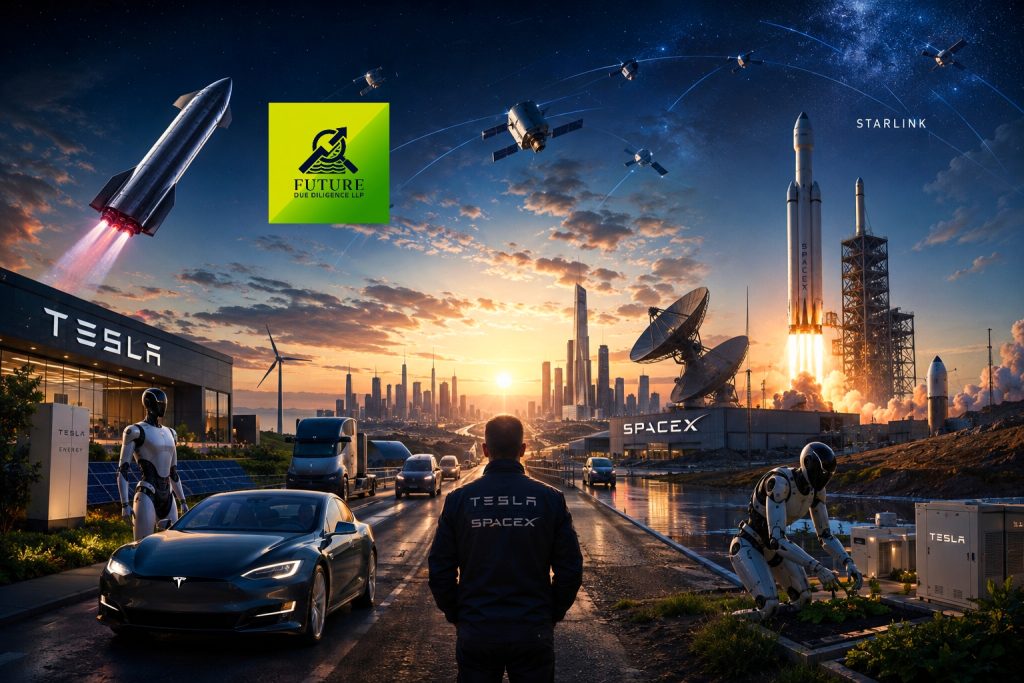
At issue is not simply whether Tesla manufactures electric vehicles or whether SpaceX launches rockets. The fundamental question is whether Elon Musk’s collection of enterprises is evolving into a vertically integrated platform controlling critical portions of future transportation, communications, energy, robotics, artificial intelligence, and potentially space-based infrastructure.
Should current strategic trajectories continue, the market may be witnessing the formation of one of the most comprehensive industrial technology platforms in modern economic history.
Current Market Position
Tesla
Tesla currently trades near $424 per share with an estimated market capitalization of approximately $1.56 trillion.
Tesla’s business operations now extend significantly beyond automotive manufacturing and include:
Battery production
Grid-scale energy storage
Solar generation systems
Artificial intelligence development
Autonomous vehicle technologies
Humanoid robotics through Optimus
Manufacturing automation
AI compute infrastructure
Although vehicle production remains the primary revenue generator, investor valuations increasingly reflect expectations surrounding autonomous transportation, robotics, and artificial intelligence.
SpaceX
SpaceX is reportedly preparing for an IPO valuation of approximately $1.75 trillion.
Current business segments include:
Orbital launch services
National security launch contracts
Satellite deployment
Lunar mission support
Deep-space transportation development
Starlink global communications infrastructure
SpaceX has established a dominant position within commercial launch markets and continues to expand its Starlink satellite constellation into one of the world’s largest communications networks.
The Starship program further positions the company as a long-term participant in potential lunar, Martian, and orbital industrial activities.
The Strategic Convergence Thesis
Future Due Diligence LLP identifies a developing convergence thesis centered upon six interconnected technology pillars.
1. Artificial Intelligence
Tesla and SpaceX increasingly rely upon advanced AI systems.
Applications include:
Autonomous driving
Robotics
Satellite operations
Manufacturing optimization
Predictive maintenance
Defense and aerospace systems
Control of AI infrastructure provides a foundational capability that supports every other operating segment.
2. Energy Infrastructure
Tesla’s energy business provides:
Battery storage
Grid stabilization
Renewable energy integration
Distributed power systems
Future energy requirements for AI data centers, robotics facilities, manufacturing operations, and transportation systems create substantial strategic value for vertically integrated energy providers.
3. Transportation Networks
Tesla operates within terrestrial transportation.
SpaceX operates within orbital transportation.
Collectively, these organizations span:
Personal mobility
Commercial logistics
Autonomous transport
Orbital launch systems
Interplanetary transportation concepts
Few corporations possess comparable transportation breadth.
4. Communications Infrastructure
Starlink may ultimately represent one of SpaceX’s most valuable assets.
The network currently provides:
Broadband internet access
Remote connectivity
Enterprise communications
Government services
Defense applications
A globally distributed communications network creates strategic advantages that extend far beyond consumer internet subscriptions.
5. Robotics
Tesla’s Optimus initiative represents an attempt to commercialize general-purpose humanoid robotics.
Potential future applications include:
Manufacturing
Warehousing
Agriculture
Healthcare support
Construction
Space operations
If commercially successful, robotics could become a labor-multiplication platform affecting virtually every economic sector.
6. Space Infrastructure
SpaceX remains uniquely positioned among private enterprises to participate in:
Lunar logistics
Orbital manufacturing
Satellite services
Space resource utilization
Deep-space transportation
Although many of these markets remain immature, investors frequently assign value based on future optionality rather than current revenue generation.
Potential Merger Considerations
Public reports indicate increasing discussion among analysts regarding the possibility of a future Tesla-SpaceX combination.
No formal merger announcement currently exists.
However, strategic rationale could include:
Operational Synergies
Potential integration opportunities include:
Shared AI systems
Unified engineering resources
Combined manufacturing capabilities
Consolidated data infrastructure
Shared energy technologies
Capital Market Efficiency
A combined entity could potentially access:
Lower financing costs
Greater institutional participation
Enhanced global liquidity
Expanded index inclusion
Technology Platform Consolidation
A merger could create a single enterprise spanning:
Electric vehicles
Autonomous transportation
Robotics
Artificial intelligence
Satellite communications
Space transportation
Energy infrastructure
Such a combination would resemble a technology-industrial platform rather than a traditional corporation.
Risks and Challenges
Despite substantial strategic opportunities, Future Due Diligence LLP identifies significant risks.
●Valuation Risk
The proposed SpaceX valuation implies substantial future growth expectations.
Should revenue expansion fail to meet projections, valuation compression could occur.
●Regulatory Risk
A combined Tesla-SpaceX structure would likely face:
Antitrust scrutiny
Securities review
International regulatory evaluation
National security considerations
●Execution Risk
Simultaneously operating within multiple complex industries introduces:
Management complexity
Capital allocation challenges
Strategic prioritization conflicts
●Market Risk
Technology valuations remain sensitive to:
Interest rates
Capital availability
Economic growth
Investor sentiment
Large-scale valuation adjustments could materially impact shareholder returns.
●Long-Term Strategic Outlook
Future Due Diligence LLP believes the most important observation is not the individual valuation of Tesla or SpaceX.
The larger strategic development is the emergence of integrated technology ecosystems controlling multiple layers of economic infrastructure simultaneously.
Historically, corporations specialized in individual sectors.
The emerging model increasingly integrates:
Energy production
Communications networks
Transportation systems
Artificial intelligence
Robotics
Manufacturing
Data infrastructure
If Tesla and SpaceX continue along their present trajectories—whether independently or through future consolidation—they may represent one of the clearest examples of this next-generation corporate architecture.
●Final Thoughts
From a due diligence perspective, investors should view Tesla and SpaceX not merely as automotive and aerospace companies.
The evidence increasingly suggests that capital markets are valuing these enterprises as foundational infrastructure platforms for a future economy driven by artificial intelligence, autonomous systems, energy independence, global communications, advanced manufacturing, and potentially space-based commerce.
The proposed $1.75 trillion SpaceX IPO valuation and Tesla’s existing $1.56 trillion market capitalization indicate that markets are already pricing in substantial portions of this future vision.
Whether those expectations ultimately prove justified will depend upon execution, regulatory developments, technological advancement, and market adoption over the next decade.
What remains clear is that the strategic significance of these organizations now extends far beyond their original industries. The investment thesis has evolved from automobiles and rockets to the possibility of controlling multiple layers of the future global economic operating system.