Every major business decision carries risk.
The question is not whether risk exists. The question is whether you understand the risk well enough to make an intelligent decision before you commit capital, resources, relationships, reputation, or operational capacity.
The businesses, investors, entrepreneurs, and strategic leaders that consistently create value are not necessarily the ones that avoid risk. They are the ones that learn how to identify it, investigate it, quantify it, manage it, and recognize the opportunity that may exist inside it.
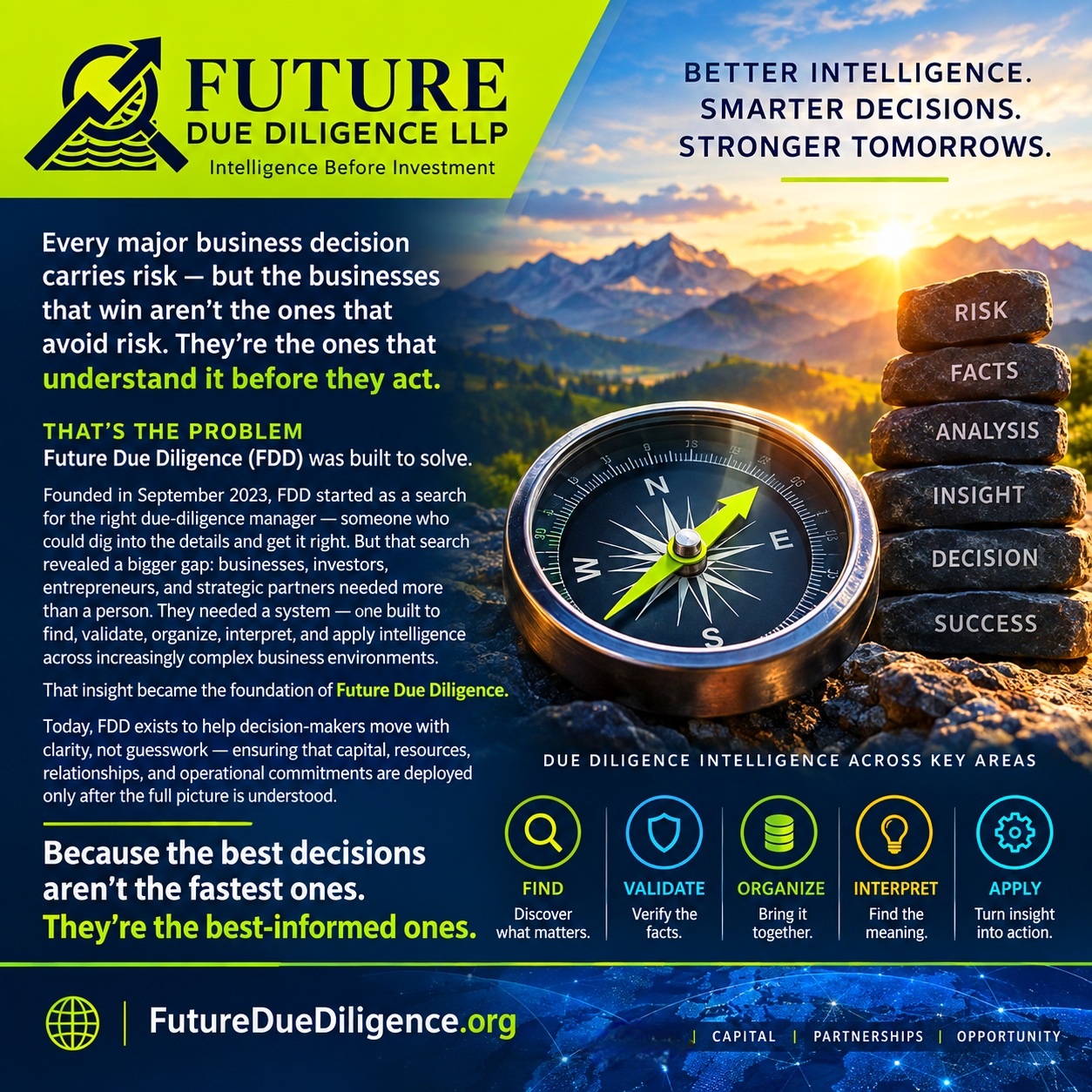
That is the problem Future Due Diligence LLP was built to solve.
Intelligence Before Investment
Founded in September 2023, Future Due Diligence began with a straightforward search: finding the right due-diligence manager—someone capable of digging beyond the surface, validating information, connecting the dots, and getting the details right.
But the search revealed something much bigger.
The challenge was not simply finding the right person.
The challenge was building the right system.
Modern business decisions increasingly involve fragmented information, rapidly changing markets, complex ownership structures, emerging technologies, regulatory uncertainty, supply-chain exposure, competitive pressure, geopolitical developments, and relationships that can materially affect the outcome of an investment or strategic commitment.
A conventional checklist can identify documents.
It cannot always identify the story those documents are telling.
That distinction became the foundation of Future Due Diligence.
FDD was created around a simple principle:
Intelligence should come before investment.
Before capital moves, understand the opportunity.
Before a partnership is formed, understand the partner.
Before an acquisition is pursued, understand the business.
Before resources are committed, understand the environment in which those resources will operate.
Before a strategic decision becomes an operational commitment, understand the assumptions behind it.
From Due Diligence to Decision Intelligence
Traditional due diligence often focuses on confirming whether information is accurate, complete, and compliant.
That remains important.
But today’s business environment demands more.
Decision-makers need to know not only what is true, but also what it means.
They need to understand the relationships between economic conditions, market behavior, competitors, technology, regulation, supply chains, leadership, customers, geography, capital, and emerging opportunities.
This is where Future Due Diligence operates.
FDD approaches due diligence as an intelligence discipline.
The objective is to find information, validate information, organize information, interpret information, and ultimately convert information into actionable intelligence.
That distinction matters.
Information tells you what happened.
Intelligence helps you understand why it happened, what could happen next, what it could mean for your position, and what decisions may be available to you.
The Full Picture Matters
A business can look attractive on paper and still contain significant exposure.
Revenue can be growing while margins deteriorate.
A company can have impressive customers while depending too heavily on one relationship.
A market can be expanding while competition is accelerating even faster.
An acquisition can appear inexpensive while carrying hidden operational liabilities.
A strategic partnership can create opportunity while simultaneously introducing reputational, contractual, technological, or concentration risk.
A supply chain can function perfectly—until one critical dependency fails.
The objective of intelligence-driven due diligence is not to create fear.
It is to eliminate avoidable surprises.
FDD seeks to identify the variables that can materially affect a decision before those variables become expensive problems.
Follow the Evidence
Future Due Diligence operates from a straightforward framework:
Follow the evidence.
Identify the convergence.
Quantify the risk.
Find the opportunity.
Following the evidence means resisting assumptions and pursuing verifiable information.
Identifying the convergence means looking beyond individual data points and examining where multiple trends, organizations, markets, technologies, economic conditions, or risks intersect.
Quantifying the risk means moving beyond vague warnings and determining the potential significance of identified exposures.
Finding the opportunity means recognizing that intelligence is not exclusively defensive.
Sometimes the same conditions creating risk are also creating opportunity.
Disruption creates openings.
Market inefficiency creates openings.
Technological change creates openings.
Regulatory change creates openings.
Supply-chain realignment creates openings.
Capital constraints create openings.
The objective is to understand those conditions before committing to a course of action.
Intelligence Is an Asset
In an increasingly complex economy, intelligence should be treated as business infrastructure.
It can influence where a company invests.
Who it partners with.
What it acquires.
Which markets it enters.
Which risks it accepts.
Which risks it rejects.
Where it allocates personnel and capital.
And, perhaps most importantly, when it decides to act.
That makes intelligence more than a research function.
It becomes part of strategic execution.
Future Due Diligence is designed to support that process by bringing together business intelligence, economic intelligence, competitive intelligence, field intelligence, risk analysis, technology research, artificial intelligence, and strategic investigation.
The goal is not to produce information for information’s sake.
The goal is to improve the quality of the decision.
Boots on the Ground. Intelligence in the System.
Some questions can not be answered from a spreadsheet.
Sometimes, the information required to understand an opportunity exists outside conventional databases, reports, presentations, or corporate websites.
It may require conversations.
Observation.
Interviews.
Local market intelligence.
Competitive research.
Site-level investigation.
Photographs and video.
Direct verification.
Context from people actually operating within the environment being evaluated.
That is why FDD’s intelligence model can incorporate both analytical research and field intelligence.
The objective is to move beyond assumptions made from a distance and develop a more complete understanding of what is actually happening on the ground.
Technology and artificial intelligence can accelerate the collection, organization, comparison, and analysis of information.
But technology does not eliminate the need for judgment.
It makes disciplined judgment more important.
The future of due diligence will not be human versus AI.
It will be intelligent systems helping capable decision-makers investigate more deeply, identify patterns faster, challenge assumptions, and make better-informed decisions.
Clarity Before Capital Moves
Capital is finite.
Time is finite.
Management attention is finite.
Relationships are valuable.
Reputation is difficult to rebuild.
Operational capacity can not be infinitely expanded.
Every major commitment, therefore, carries an opportunity cost.
When resources are deployed into the wrong opportunity, they are unavailable for the right one.
That is why clarity matters before commitment.
Future Due Diligence exists to help decision-makers answer the questions that should come before the money moves:
What are we actually looking at?
What do we know?
What don’t we know?
What can be independently verified?
What assumptions are we making?
Where are the vulnerabilities?
What risks could materially change the outcome?
Who else is involved?
What market forces are converging around this opportunity?
What happens if our assumptions are wrong?
And where is the opportunity that others may be overlooking?
These are not simply due-diligence questions.
They are leadership questions.
The Future Requires Better Intelligence
Business is moving faster.
Artificial intelligence is changing operating models.
Capital is becoming more selective.
Supply chains are being redesigned.
Geopolitical conditions are affecting commercial decisions.
Regulatory environments are evolving.
Technology cycles are shortening.
Competition is increasingly global.
And information itself is becoming both more abundant and more difficult to distinguish from noise.
In that environment, having more information does not automatically create an advantage.
Knowing how to determine what matters does.
Future Due Diligence was built for that environment.
The mission is not to eliminate uncertainty. That is impossible.
The mission is to reduce unnecessary uncertainty so decision-makers can move with greater clarity, confidence, and strategic discipline.
Because the objective of due diligence is not simply to find reasons to say no.
It is to determine whether the evidence supports yes, no, not yet, or proceed differently.
That distinction can change everything.
Intelligence Before Investment
Every investment begins with a decision.
Every partnership begins with a decision.
Every acquisition begins with a decision.
Every expansion begins with a decision.
Every major strategic commitment begins with a decision.
The quality of those decisions depends on the quality of the intelligence behind them.
Future Due Diligence LLP exists to help decision-makers build that intelligence before they commit.
Follow the evidence.
Identify the convergence.
Quantify the risk.
Find the opportunity.
Because the best decisions are not always the fastest decisions.
They are the decisions made with the clearest understanding of what is actually in front of you.
Future Due Diligence LLP
Intelligence Before Investment.
Built From the Search for Better Intelligence.
Clarity Before Capital Moves.
Tag: Due Diligence
-
Future Due Diligence LLP: Intelligence Before Investment
-
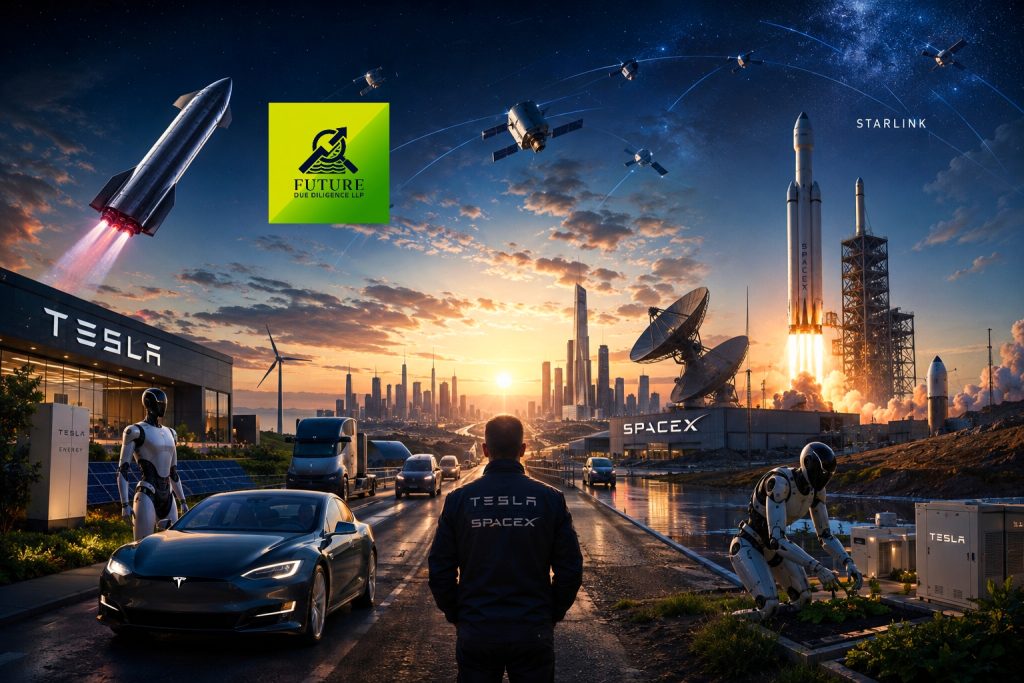
Tesla, SpaceX, and the Emergence of a Potential Multi-Trillion-Dollar Technology Infrastructure Platform
Future Due Diligence LLP
Strategic Intelligence Brief
Tesla, SpaceX, and the Emergence of a Potential Multi-Trillion-Dollar Technology Infrastructure Platform
June 2026
Executive Summary~
Future Due Diligence LLP has conducted a preliminary strategic assessment of recent developments involving Tesla and SpaceX following reports that SpaceX intends to proceed with an initial public offering priced at approximately $135 per share, implying a valuation near $1.75 trillion. Simultaneously, Tesla maintains a market capitalization of approximately $1.56 trillion, placing both organizations among the most valuable corporate enterprises globally.
The significance of these developments extends beyond public market activity. Investors, institutional capital providers, sovereign wealth funds, technology analysts, and industrial strategists are increasingly evaluating whether the future value proposition of these organizations lies not within their individual operating segments but within the possibility of a broader integrated technology infrastructure ecosystem.
At issue is not simply whether Tesla manufactures electric vehicles or whether SpaceX launches rockets. The fundamental question is whether Elon Musk’s collection of enterprises is evolving into a vertically integrated platform controlling critical portions of future transportation, communications, energy, robotics, artificial intelligence, and potentially space-based infrastructure.
Should current strategic trajectories continue, the market may be witnessing the formation of one of the most comprehensive industrial technology platforms in modern economic history.
Current Market Position
Tesla
Tesla currently trades near $424 per share with an estimated market capitalization of approximately $1.56 trillion.
Tesla’s business operations now extend significantly beyond automotive manufacturing and include:
Battery production
Grid-scale energy storage
Solar generation systems
Artificial intelligence development
Autonomous vehicle technologies
Humanoid robotics through Optimus
Manufacturing automation
AI compute infrastructure
Although vehicle production remains the primary revenue generator, investor valuations increasingly reflect expectations surrounding autonomous transportation, robotics, and artificial intelligence.
SpaceX
SpaceX is reportedly preparing for an IPO valuation of approximately $1.75 trillion.
Current business segments include:
Orbital launch services
National security launch contracts
Satellite deployment
Lunar mission support
Deep-space transportation development
Starlink global communications infrastructure
SpaceX has established a dominant position within commercial launch markets and continues to expand its Starlink satellite constellation into one of the world’s largest communications networks.
The Starship program further positions the company as a long-term participant in potential lunar, Martian, and orbital industrial activities.
The Strategic Convergence Thesis
Future Due Diligence LLP identifies a developing convergence thesis centered upon six interconnected technology pillars.
1. Artificial Intelligence
Tesla and SpaceX increasingly rely upon advanced AI systems.
Applications include:
Autonomous driving
Robotics
Satellite operations
Manufacturing optimization
Predictive maintenance
Defense and aerospace systems
Control of AI infrastructure provides a foundational capability that supports every other operating segment.
2. Energy Infrastructure
Tesla’s energy business provides:
Battery storage
Grid stabilization
Renewable energy integration
Distributed power systems
Future energy requirements for AI data centers, robotics facilities, manufacturing operations, and transportation systems create substantial strategic value for vertically integrated energy providers.
3. Transportation Networks
Tesla operates within terrestrial transportation.
SpaceX operates within orbital transportation.
Collectively, these organizations span:
Personal mobility
Commercial logistics
Autonomous transport
Orbital launch systems
Interplanetary transportation concepts
Few corporations possess comparable transportation breadth.
4. Communications Infrastructure
Starlink may ultimately represent one of SpaceX’s most valuable assets.
The network currently provides:
Broadband internet access
Remote connectivity
Enterprise communications
Government services
Defense applications
A globally distributed communications network creates strategic advantages that extend far beyond consumer internet subscriptions.
5. Robotics
Tesla’s Optimus initiative represents an attempt to commercialize general-purpose humanoid robotics.
Potential future applications include:
Manufacturing
Warehousing
Agriculture
Healthcare support
Construction
Space operations
If commercially successful, robotics could become a labor-multiplication platform affecting virtually every economic sector.
6. Space Infrastructure
SpaceX remains uniquely positioned among private enterprises to participate in:
Lunar logistics
Orbital manufacturing
Satellite services
Space resource utilization
Deep-space transportation
Although many of these markets remain immature, investors frequently assign value based on future optionality rather than current revenue generation.
Potential Merger Considerations
Public reports indicate increasing discussion among analysts regarding the possibility of a future Tesla-SpaceX combination.
No formal merger announcement currently exists.
However, strategic rationale could include:
Operational Synergies
Potential integration opportunities include:
Shared AI systems
Unified engineering resources
Combined manufacturing capabilities
Consolidated data infrastructure
Shared energy technologies
Capital Market Efficiency
A combined entity could potentially access:
Lower financing costs
Greater institutional participation
Enhanced global liquidity
Expanded index inclusion
Technology Platform Consolidation
A merger could create a single enterprise spanning:
Electric vehicles
Autonomous transportation
Robotics
Artificial intelligence
Satellite communications
Space transportation
Energy infrastructure
Such a combination would resemble a technology-industrial platform rather than a traditional corporation.
Risks and Challenges
Despite substantial strategic opportunities, Future Due Diligence LLP identifies significant risks.
●Valuation Risk
The proposed SpaceX valuation implies substantial future growth expectations.
Should revenue expansion fail to meet projections, valuation compression could occur.
●Regulatory Risk
A combined Tesla-SpaceX structure would likely face:
Antitrust scrutiny
Securities review
International regulatory evaluation
National security considerations
●Execution Risk
Simultaneously operating within multiple complex industries introduces:
Management complexity
Capital allocation challenges
Strategic prioritization conflicts
●Market Risk
Technology valuations remain sensitive to:
Interest rates
Capital availability
Economic growth
Investor sentiment
Large-scale valuation adjustments could materially impact shareholder returns.
●Long-Term Strategic Outlook
Future Due Diligence LLP believes the most important observation is not the individual valuation of Tesla or SpaceX.
The larger strategic development is the emergence of integrated technology ecosystems controlling multiple layers of economic infrastructure simultaneously.
Historically, corporations specialized in individual sectors.
The emerging model increasingly integrates:
Energy production
Communications networks
Transportation systems
Artificial intelligence
Robotics
Manufacturing
Data infrastructure
If Tesla and SpaceX continue along their present trajectories—whether independently or through future consolidation—they may represent one of the clearest examples of this next-generation corporate architecture.
●Final Thoughts
From a due diligence perspective, investors should view Tesla and SpaceX not merely as automotive and aerospace companies.
The evidence increasingly suggests that capital markets are valuing these enterprises as foundational infrastructure platforms for a future economy driven by artificial intelligence, autonomous systems, energy independence, global communications, advanced manufacturing, and potentially space-based commerce.
The proposed $1.75 trillion SpaceX IPO valuation and Tesla’s existing $1.56 trillion market capitalization indicate that markets are already pricing in substantial portions of this future vision.
Whether those expectations ultimately prove justified will depend upon execution, regulatory developments, technological advancement, and market adoption over the next decade.
What remains clear is that the strategic significance of these organizations now extends far beyond their original industries. The investment thesis has evolved from automobiles and rockets to the possibility of controlling multiple layers of the future global economic operating system. -
Future Business Intelligence
The Future of Business Is Built on Intelligence
By Future Due Diligence LLP
12/28/2025
The global economy has crossed a hard threshold. Volatility is no longer episodic—it is structural. Market cycles have compressed, geopolitical risk has gone mainstream, capital has become more selective, and technology is advancing faster than governance, regulation, and human adaptation can follow. In this environment, the winners going into 2026 and beyond will not be the organizations with the most data—but the ones with the clearest intelligence.
That distinction matters.
Information Is Abundant. Intelligence Is Scarce.
We live in a world drowning in data. Financials, market reports, dashboards, news feeds, and AI-generated summaries are everywhere. Yet despite this abundance, leadership teams are making higher-stakes decisions with less clarity than ever before.
Why? Because information describes the past.
Intelligence interprets the present and anticipates the future.
Traditional due diligence models were built for a slower economy—one where risks were linear, competitors were visible, and change was incremental. Static reports, point-in-time assessments, and backward-looking analysis are no longer fit for purpose. By the time a conventional diligence report is completed, the risk landscape has already shifted.
That is not diligence. That is exposure.
Due Diligence Must Evolve into Strategic Foresight
At Future Due Diligence LLP, we operate from a simple but uncompromising premise:
Due diligence is no longer a compliance function—it is a strategic weapon.
Modern business leaders are not asking:
• “What happened?” They are asking:
• “What’s changing?”
• “What’s being underestimated?”
• “Where is risk compounding silently?”
• “What opportunity will our competitors see too late?”
Answering those questions requires more than data aggregation. It requires intelligence architecture—systems designed to detect weak signals, connect non-obvious variables, and surface implications before they become headlines.
AI Alone Is Not the Solution — Intelligence Is
AI has introduced speed, scale, and pattern recognition at levels previously unimaginable. But raw AI outputs without context, judgment, and domain expertise simply create faster noise.
Our approach integrates:
• AI-driven analytics to process complex, multi-source data at scale
• Machine learning models to identify trends, anomalies, and forward indicators
• Human intelligence and sector expertise to challenge assumptions, validate signals, and translate insight into executive action
The result is not more dashboards—it is decision-ready intelligence.
Intelligence that is:
• Predictive, not reactive
• Dynamic, not static
• Strategic, not operational
The New Mandate for Leadership Going into 2026
As we move toward 2026, the mandate for boards, investors, and executive teams is clear:
• Risk is no longer isolated—it is interconnected
• Opportunity windows are shorter and more asymmetric
• Trust, resilience, and foresight are becoming valuation drivers
• Speed without insight is a liability
Organizations that continue to rely on legacy due diligence will find themselves consistently late—late to risk, late to opportunity, late to market reality.
Those that invest in intelligence will:
• Anticipate disruption instead of reacting to it
• Allocate capital with conviction, not guesswork
• Enter partnerships and acquisitions with clarity, not optimism
• Build strategies that endure volatility rather than collapse under it
This Is Not About Moving Faster — It’s About Seeing Further
At Future Due Diligence LLP, we are not in the business of speeding up bad decisions. We are in the business of making better ones earlier.
The companies that will dominate the next decade are not chasing trends—they are reading the terrain before it shifts. They understand that intelligence compounds. And they treat due diligence as a living, strategic process—not a box to be checked.
The future will not reward those who know the most.
It will reward those who understand the most—soonest.
Transform your due diligence.
Elevate your intelligence.
Build forward with confidence.
The Future of Business Is Built on Intelligence — Not Just Information -
The Future of Business Is Built on Intelligence — Not Just Information
By Future Due Diligence LLP
🔗 futureduediligence.org
The End of Business as Usual
In today’s hyperconnected global economy, the pace of disruption has fundamentally altered the rules of survival and success. Industries that once evolved gradually across decades now undergo complete transformations within months. Market leaders are dethroned by competitors who didn’t exist a year ago. Regulatory frameworks shift beneath our feet. Geopolitical events cascade across supply chains in real time.
The era of predictable business cycles is over.
Yet most organizations continue to make critical decisions—mergers, expansions, partnerships, capital allocations—using the same backward-looking methodologies that were designed for a slower, more stable world. Traditional due diligence, built on static reports, historical financial statements, and reactive risk assessments, cannot keep pace with the velocity and complexity of modern business reality.
The gap between the speed of change and the speed of understanding has become the most dangerous vulnerability in business today.
From Information Overload to Intelligence Advantage
We live in an age of unprecedented access to information. Every transaction leaves a digital footprint. Every market shift generates data. Every stakeholder creates content. Yet despite—or perhaps because of—this deluge, decision-makers often find themselves paralyzed rather than empowered.
Information without context is noise. Data without meaning is a liability.
At Future Due Diligence LLP, we recognize a fundamental truth: the competitive advantage of tomorrow belongs not to those who have the most information, but to those who possess the deepest intelligence.
Intelligence is information transformed—refined, contextualized, synthesized, and made actionable. It’s the difference between knowing what happened and understanding what it means. Between seeing patterns and anticipating what comes next. Between reacting to change and positioning yourself ahead of it.
This is the new foundation of strategic decision-making. This is where foresight replaces hindsight. Where confidence replaces hesitation.
Our Approach: Where Technology Meets Insight
We’ve built our platform on a simple but powerful principle: the future demands a fusion of artificial and human intelligence.
Our AI-driven due diligence ecosystem doesn’t just aggregate data—it transforms fragmented, disparate information streams into curated, predictive intelligence. We deploy advanced analytics and machine learning algorithms that can identify emerging patterns across thousands of variables simultaneously, detecting signals that traditional analysis would miss entirely.
But technology alone isn’t enough. Algorithms can process; only humans can interpret. Numbers reveal; experience understands. Our platform integrates expert human insight at critical junctures, ensuring that every analysis is grounded in real-world context, industry nuance, and strategic wisdom.
The result is something unprecedented: clear, multidimensional intelligence that doesn’t just describe the present—it illuminates multiple potential futures, each with its own risk profile and opportunity landscape.
What This Means for Your Organization
Anticipate, Don’t React
Stop playing catch-up with market movements. Our predictive analytics identify inflection points before they become obvious, giving you the lead time to position strategically rather than scramble reactively.
See Around Corners
Understand the second- and third-order effects of decisions, market shifts, and external events. Map the invisible connections between seemingly unrelated factors. Recognize threats while they’re still emerging opportunities—and opportunities while they’re still overlooked by competitors.
Make Decisions with Conviction
Replace uncertainty with clarity. Move from “we think” to “we know”—or at least “we understand the probabilities.” Defend your choices with evidence-based foresight that satisfies boards, investors, and your own standards for excellence.
Transform Risk into Advantage
While others see volatility as a threat to be minimized, see it as asymmetry to be exploited. Understanding complexity better than your competition doesn’t just reduce your downside—it reveals pathways to outsized returns that others cannot perceive.
Build Organizational Resilience
Develop the capability to thrive amid disruption. Create decision-making frameworks that remain robust even when assumptions change. Cultivate the institutional intelligence that becomes your most defensible competitive moat.
The Strategic Imperative
This isn’t about incrementally improving your existing due diligence process. This is about fundamentally reimagining what due diligence means in an age of exponential change.
This is not about reacting faster—it’s about thinking differently.
It’s not about having better hindsight—it’s about developing foresight.
It’s not about managing uncertainty—it’s about mastering it.
The companies that will lead their industries over the next decade won’t be those with the biggest war chests or the longest track records. They’ll be the organizations that can see what’s coming before others recognize what’s already here. They’ll be the decision-makers who understand that in a world of constant disruption, the only sustainable advantage is the ability to continuously anticipate and adapt.
The future belongs to those who can see it taking shape.
Will you be among them?
Your Next Move
The question isn’t whether disruption is coming to your industry—it’s already here. The question is whether you’ll recognize it in time to turn it to your advantage.
Traditional due diligence tells you about the past. We help you prepare for futures that haven’t yet materialized—and capitalize on them when they do.
Transform your due diligence. Elevate your intelligence. Future-proof your decisions.
Discover what’s possible at futureduediligence.org
Future Due Diligence LLP — Intelligence for the Age of Disruption
Futureduediligence.org -
Future Due Diligence LLP
Future Due Diligence LLP aims to revolutionize due diligence for potential investors by providing comprehensive investigations into the financial, commercial, cyber security, and political aspects of businesses. Our specialized services will empower investors to make informed decisions, mitigating risks associated with their investments.
Established in September 2023, Future Due Diligence LLP emerged with a vision to redefine the standard of due diligence in the modern business era. Recognizing the growing need for precise and actionable insights, we leverage advanced AI technologies and expert human oversight to deliver unparalleled clarity, confidence, and value to our clients. Our mission is to empower businesses and investors to navigate complexities, mitigate risks, and unlock opportunities that drive sustainable success.