Every major business decision carries risk.
The question is not whether risk exists. The question is whether you understand the risk well enough to make an intelligent decision before you commit capital, resources, relationships, reputation, or operational capacity.
The businesses, investors, entrepreneurs, and strategic leaders that consistently create value are not necessarily the ones that avoid risk. They are the ones that learn how to identify it, investigate it, quantify it, manage it, and recognize the opportunity that may exist inside it.
That is the problem Future Due Diligence LLP was built to solve.
Intelligence Before Investment
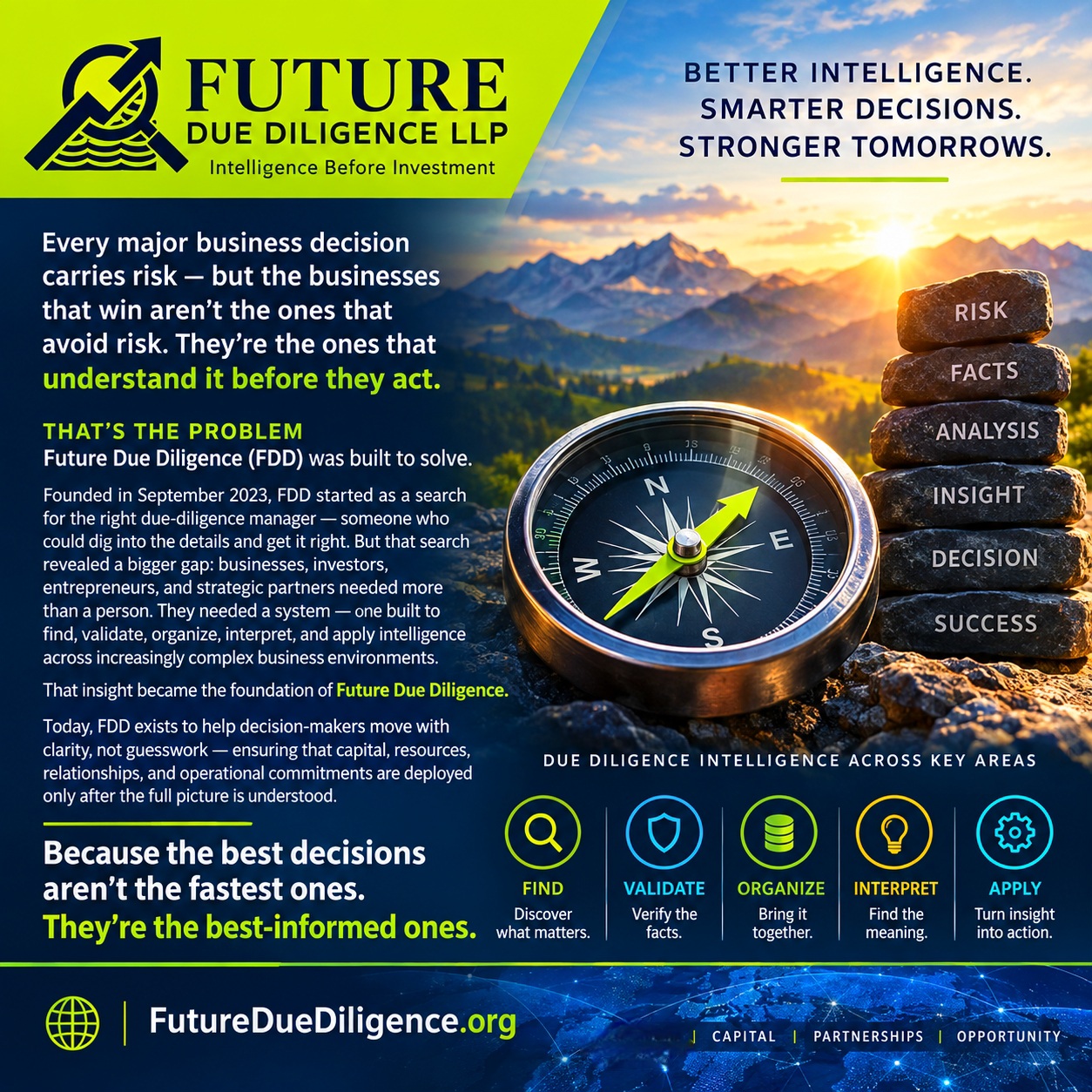
Founded in September 2023, Future Due Diligence began with a straightforward search: finding the right due-diligence manager—someone capable of digging beyond the surface, validating information, connecting the dots, and getting the details right.
But the search revealed something much bigger.
The challenge was not simply finding the right person.
The challenge was building the right system.
Modern business decisions increasingly involve fragmented information, rapidly changing markets, complex ownership structures, emerging technologies, regulatory uncertainty, supply-chain exposure, competitive pressure, geopolitical developments, and relationships that can materially affect the outcome of an investment or strategic commitment.
A conventional checklist can identify documents.
It cannot always identify the story those documents are telling.
That distinction became the foundation of Future Due Diligence.
FDD was created around a simple principle:
Intelligence should come before investment.
Before capital moves, understand the opportunity.
Before a partnership is formed, understand the partner.
Before an acquisition is pursued, understand the business.
Before resources are committed, understand the environment in which those resources will operate.
Before a strategic decision becomes an operational commitment, understand the assumptions behind it.
From Due Diligence to Decision Intelligence
Traditional due diligence often focuses on confirming whether information is accurate, complete, and compliant.
That remains important.
But today’s business environment demands more.
Decision-makers need to know not only what is true, but also what it means.
They need to understand the relationships between economic conditions, market behavior, competitors, technology, regulation, supply chains, leadership, customers, geography, capital, and emerging opportunities.
This is where Future Due Diligence operates.
FDD approaches due diligence as an intelligence discipline.
The objective is to find information, validate information, organize information, interpret information, and ultimately convert information into actionable intelligence.
That distinction matters.
Information tells you what happened.
Intelligence helps you understand why it happened, what could happen next, what it could mean for your position, and what decisions may be available to you.
The Full Picture Matters
A business can look attractive on paper and still contain significant exposure.
Revenue can be growing while margins deteriorate.
A company can have impressive customers while depending too heavily on one relationship.
A market can be expanding while competition is accelerating even faster.
An acquisition can appear inexpensive while carrying hidden operational liabilities.
A strategic partnership can create opportunity while simultaneously introducing reputational, contractual, technological, or concentration risk.
A supply chain can function perfectly—until one critical dependency fails.
The objective of intelligence-driven due diligence is not to create fear.
It is to eliminate avoidable surprises.
FDD seeks to identify the variables that can materially affect a decision before those variables become expensive problems.
Follow the Evidence
Future Due Diligence operates from a straightforward framework:
Follow the evidence.
Identify the convergence.
Quantify the risk.
Find the opportunity.
Following the evidence means resisting assumptions and pursuing verifiable information.
Identifying the convergence means looking beyond individual data points and examining where multiple trends, organizations, markets, technologies, economic conditions, or risks intersect.
Quantifying the risk means moving beyond vague warnings and determining the potential significance of identified exposures.
Finding the opportunity means recognizing that intelligence is not exclusively defensive.
Sometimes the same conditions creating risk are also creating opportunity.
Disruption creates openings.
Market inefficiency creates openings.
Technological change creates openings.
Regulatory change creates openings.
Supply-chain realignment creates openings.
Capital constraints create openings.
The objective is to understand those conditions before committing to a course of action.
Intelligence Is an Asset
In an increasingly complex economy, intelligence should be treated as business infrastructure.
It can influence where a company invests.
Who it partners with.
What it acquires.
Which markets it enters.
Which risks it accepts.
Which risks it rejects.
Where it allocates personnel and capital.
And, perhaps most importantly, when it decides to act.
That makes intelligence more than a research function.
It becomes part of strategic execution.
Future Due Diligence is designed to support that process by bringing together business intelligence, economic intelligence, competitive intelligence, field intelligence, risk analysis, technology research, artificial intelligence, and strategic investigation.
The goal is not to produce information for information’s sake.
The goal is to improve the quality of the decision.
Boots on the Ground. Intelligence in the System.
Some questions can not be answered from a spreadsheet.
Sometimes, the information required to understand an opportunity exists outside conventional databases, reports, presentations, or corporate websites.
It may require conversations.
Observation.
Interviews.
Local market intelligence.
Competitive research.
Site-level investigation.
Photographs and video.
Direct verification.
Context from people actually operating within the environment being evaluated.
That is why FDD’s intelligence model can incorporate both analytical research and field intelligence.
The objective is to move beyond assumptions made from a distance and develop a more complete understanding of what is actually happening on the ground.
Technology and artificial intelligence can accelerate the collection, organization, comparison, and analysis of information.
But technology does not eliminate the need for judgment.
It makes disciplined judgment more important.
The future of due diligence will not be human versus AI.
It will be intelligent systems helping capable decision-makers investigate more deeply, identify patterns faster, challenge assumptions, and make better-informed decisions.
Clarity Before Capital Moves
Capital is finite.
Time is finite.
Management attention is finite.
Relationships are valuable.
Reputation is difficult to rebuild.
Operational capacity can not be infinitely expanded.
Every major commitment, therefore, carries an opportunity cost.
When resources are deployed into the wrong opportunity, they are unavailable for the right one.
That is why clarity matters before commitment.
Future Due Diligence exists to help decision-makers answer the questions that should come before the money moves:
What are we actually looking at?
What do we know?
What don’t we know?
What can be independently verified?
What assumptions are we making?
Where are the vulnerabilities?
What risks could materially change the outcome?
Who else is involved?
What market forces are converging around this opportunity?
What happens if our assumptions are wrong?
And where is the opportunity that others may be overlooking?
These are not simply due-diligence questions.
They are leadership questions.
The Future Requires Better Intelligence
Business is moving faster.
Artificial intelligence is changing operating models.
Capital is becoming more selective.
Supply chains are being redesigned.
Geopolitical conditions are affecting commercial decisions.
Regulatory environments are evolving.
Technology cycles are shortening.
Competition is increasingly global.
And information itself is becoming both more abundant and more difficult to distinguish from noise.
In that environment, having more information does not automatically create an advantage.
Knowing how to determine what matters does.
Future Due Diligence was built for that environment.
The mission is not to eliminate uncertainty. That is impossible.
The mission is to reduce unnecessary uncertainty so decision-makers can move with greater clarity, confidence, and strategic discipline.
Because the objective of due diligence is not simply to find reasons to say no.
It is to determine whether the evidence supports yes, no, not yet, or proceed differently.
That distinction can change everything.
Intelligence Before Investment
Every investment begins with a decision.
Every partnership begins with a decision.
Every acquisition begins with a decision.
Every expansion begins with a decision.
Every major strategic commitment begins with a decision.
The quality of those decisions depends on the quality of the intelligence behind them.
Future Due Diligence LLP exists to help decision-makers build that intelligence before they commit.
Follow the evidence.
Identify the convergence.
Quantify the risk.
Find the opportunity.
Because the best decisions are not always the fastest decisions.
They are the decisions made with the clearest understanding of what is actually in front of you.
Future Due Diligence LLP
Intelligence Before Investment.
Built From the Search for Better Intelligence.
Clarity Before Capital Moves.
Future Due Diligence LLP: Intelligence Before Investment
Leave a Reply